CORE
An open scholarly infrastructure for researchers


-
Stop Dreaming. Start Executing.
Join the Ferct Founding 50 to unlock your full potential and achieve your dreams.
Exclusive Lifetime Access to Ferct – The World's First Goal Achievement Network.
SECURE YOUR SPOT NOW
-
Become a Certified Scientific Researcher
Join the world’s #1 comprehensive online skills program designed to empower college students, postgraduates, and researchers to launch or advance their careers in research and development.
Learn more
This offer for one time after that will be this closed forever. No extensions. No second chancess.
Description:
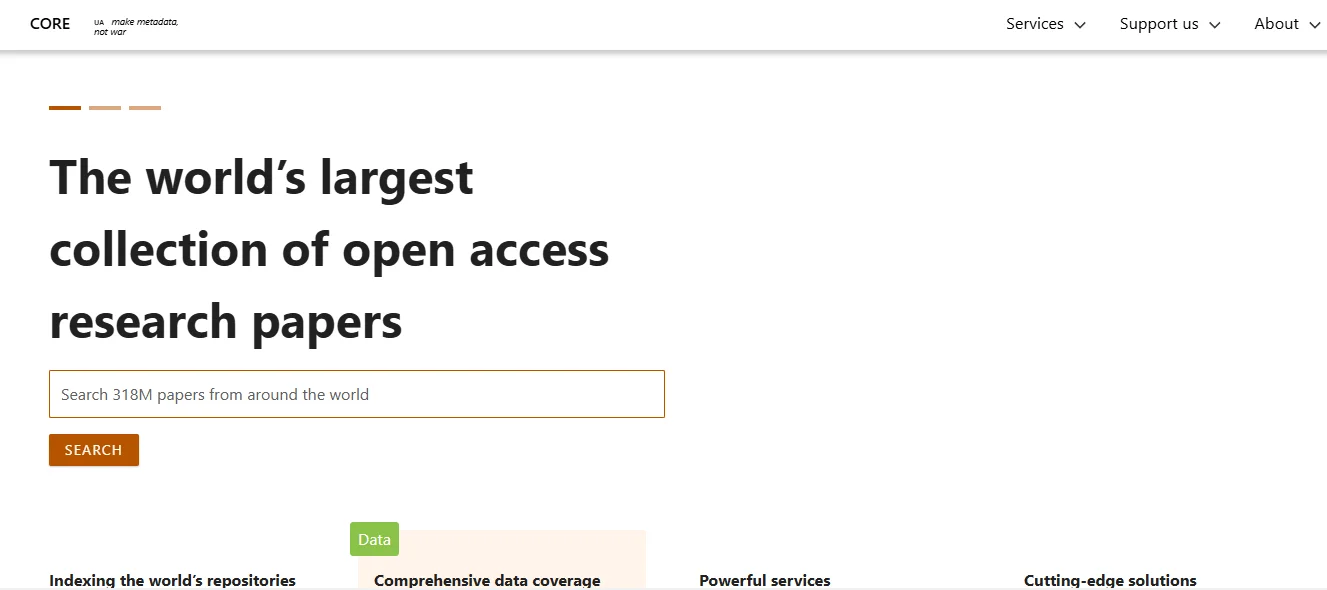
CORE (COnnecting REpositories) is an open scholarly infrastructure designed to aggregate and provide access to millions of open-access research papers. Developed by The Open University and Jisc, CORE aims to advance Open Science by facilitating free and unrestricted access to scholarly content from repositories and journals worldwide. It supports researchers, institutions, and the general public by simplifying the discovery and reuse of academic resources.
Main Features and Functions:
- Extensive Repository Aggregation:
CORE collects and indexes content from thousands of institutional repositories, open-access journals, and preprint archives, offering access to over 200 million research papers. - Open Access Emphasis:
- The platform ensures a significant portion of the content is freely accessible.
- It promotes the principles of Open Science by providing unrestricted access to research outputs.
- Advanced Search and Discovery:
- Offers a powerful search engine with filters such as keyword, author, repository, publication date, and document type.
- Displays related articles and similar research for broader discovery.
- Text and Data Mining:
- CORE allows users to perform large-scale text and data mining on its dataset for advanced analysis and research.
- CORE Recommender:
- An AI-powered tool that suggests relevant research papers based on user activity, helping researchers discover content aligned with their interests.
- Integrations and APIs:
- Institutions and developers can integrate CORE’s services into their systems using its open APIs, facilitating seamless access to aggregated scholarly content.
- Metrics and Analytics:
- Provides citation and download metrics for individual articles and aggregates insights for institutions and publishers.
- Open and Transparent Platform:
- All data is freely available for reuse, aligned with its mission to support Open Science initiatives.
Guide:
How to Use CORE
- Accessing CORE:
- Visit CORE via any web browser.
- Performing a Search:
- Enter a keyword, author, or title in the search bar.
- Use the advanced search option to narrow results by repository, language, document type, or date range.
- Exploring Results:
- Click on a result to view the abstract, metadata, and full text (if available).
- Utilize the "Related articles" section to discover similar research.
- Downloading Open Access Papers:
- CORE provides direct links to open-access versions of papers hosted on repositories or publisher sites.
- Click the "Download" button when available for immediate access.
- Leveraging the CORE Recommender:
- Browse research papers, and CORE will suggest additional relevant resources based on the current selection.
- Using Text and Data Mining Tools:
- For large-scale analysis, access CORE’s dataset or use its API to download and analyze bulk data.
- This is ideal for researchers conducting meta-analyses or bibliometric studies.
- Setting Up Institutional Integrations:
- Developers can use CORE’s API to integrate its search and discovery functionalities into library systems, websites, or applications.
- Personalized Research Discovery:
- While no user account is necessary, bookmarking or saving searches can be managed locally or through other tools.
CORE is a cornerstone of Open Science, enabling free and easy access to a vast repository of scholarly knowledge. Its focus on open access, powerful search tools, and integration options make it an indispensable resource for researchers, institutions, and the global academic community.
Main Information
Related tools